Making Peace Visible: Why We Need More Images of Peace
We live in a world saturated with images of war. Every day, news reports bring images of armed conflict, destruction, displacement and suffering into our homes. We see them on television, on our phones, on social media and in newspapers. These images are important. They document reality, inform us about what is happening and help us understand the consequences of violence.
But there is another question we rarely ask: Where are the images of peace?
How often do we consciously notice peace in our everyday lives? What does peace look like when there is no war? How can we represent the relationships, communities, choices and actions that make peaceful societies possible?
And perhaps most importantly: How can we make peace more visible?
From the absence of war to the presence of peace
When we talk about peace, it is common to define it as the opposite of war. Yet peace can mean much more than simply the absence of violence. The concept of positive peace offers another way of thinking about it. Positive peace focuses on the conditions that allow people and communities to live together with dignity and security. It can include cooperation, equality, justice, dialogue, education, trust, inclusion, social connection and the ability to resolve conflicts without violence.
This changes the question. Instead of asking only, “How can we stop war?”, we can also ask: “What kind of world do we want to build?”
Peace, in this sense, is not an empty space left behind when conflict ends. It is something active. It is something people create, maintain and practice every day. And if peace is something we create, perhaps we also need to become better at seeing and communicating it.
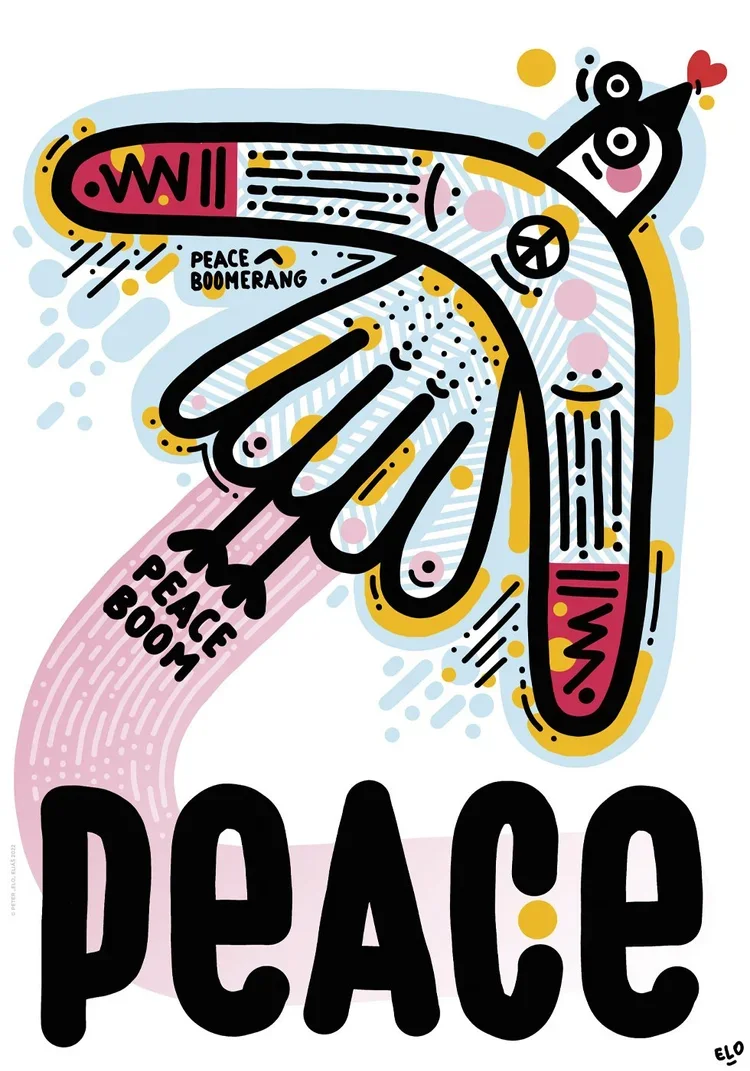
Peaceboom. 2022 Peter Eliáš
What does peace look like?
There is no single answer. For some people, peace may be connected to religion or spirituality. For others, it may mean inner peace, reflection or time spent in nature. Peace can be found in a shared meal, in a neighborhood, in friendship, in community life or in the simple experience of feeling safe and belonging somewhere. It can be represented through music, literature, architecture, education or art. For one person, peace may already be part of everyday life. For another, it may represent something that is still missing — a hope, a dream or a vision for the future. This diversity is important because it reminds us that peace is not one universal image or one universal experience. The way we imagine peace is shaped by where we come from, what we have experienced and what we hope for.
Posters as a visual language for peace
This is one of the reasons why peace posters are so interesting. Posters are powerful forms of visual communication. They can communicate an idea quickly, but they can also invite us to stop, think and question. Throughout history, posters have been used to communicate political ideas, promote social movements, raise awareness and mobilize people. They have helped societies communicate messages about war, revolution, human rights, health and social change. But visual communication can also be used to imagine something different.
What happens when we use the poster not only to protest against violence, but to imagine peace?
This question is at the heart of Posters4Peace, one of the ongoing projects of Peace Museums. Posters4Peace collects peace posters created by poster designers and artists from around the world. By bringing these works together, the project creates a growing visual archive of how people imagine peace. And when we look at these posters side by side, something fascinating happens. We begin to see how different peace can look.
Many visions, one shared aspiration
Artists from different cultural and geographical backgrounds approach peace in very different ways. Some artists respond to current events and document the reality of peace, conflict and coexistence. Others create symbolic images that communicate a particular idea or emotion. Some imagine the future — creating visual scenarios of a world that does not yet exist. Others focus on everyday experiences: family, community, nature, food, friendship or human connection. There are posters that communicate peace as an individual experience and posters that understand peace as a collective responsibility. There are quiet images and loud ones. Minimalist approaches and complex visual compositions. Familiar symbols and completely new ones. Together, they demonstrate that there is no single visual definition of peace. And perhaps this is exactly what we need.
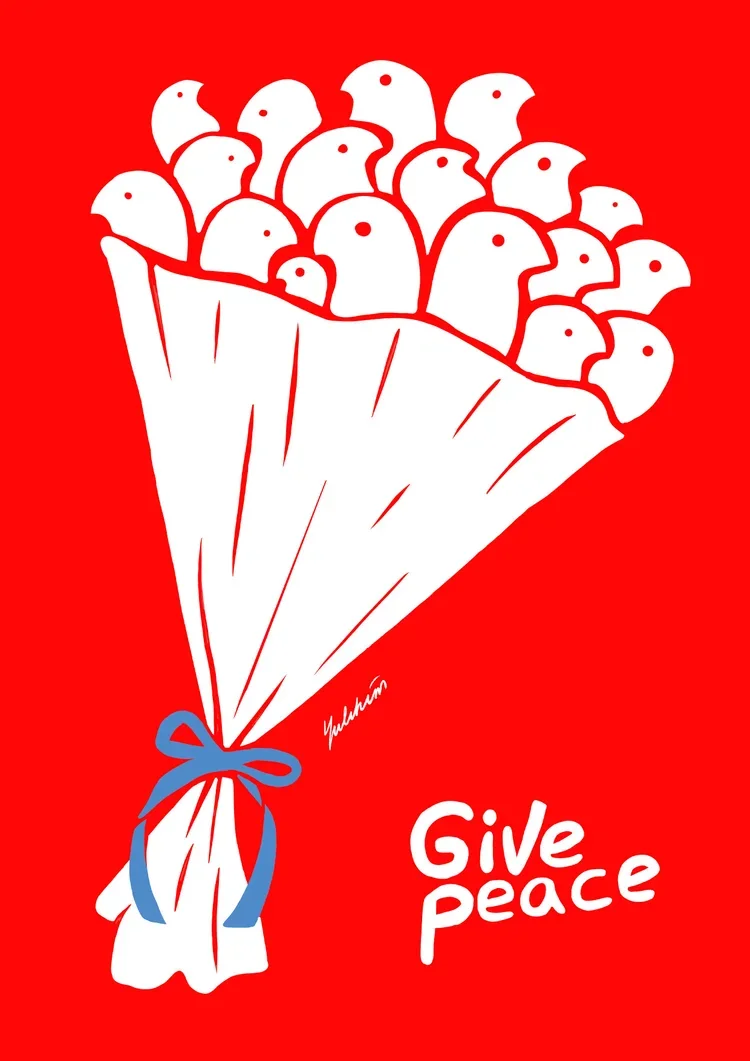
Bird feather Muzaffar Yulchiboev
Beyond the familiar symbols
When we think about peace, three symbols often immediately come to mind: the peace sign, the dove and the raised or open hand. These symbols have become part of our shared visual vocabulary. They are meaningful and powerful. But they do not have to be the end of the conversation. What if we could create more symbols for peace? What if peace could be represented through hundreds or thousands of different images? What if we allowed ourselves to experiment with new colors, forms, metaphors and stories? Perhaps a community garden can become a symbol of peace. Perhaps a table where people who are different from one another eat together. Perhaps a child playing safely. Perhaps a bridge. Perhaps a song. Perhaps something we have not imagined yet. Art gives us the freedom to explore these possibilities.
Art can document peace — but it can also imagine it
One of the most valuable things about peace art is that it can operate in two directions. It can help us notice what already exists. And it can help us imagine what does not yet exist. This second role is particularly important. Artists are not only documenting the present. They can create visions of possible futures. They can ask us to imagine societies based on cooperation rather than fear, dialogue rather than violence, and connection rather than division. In this way, making art about peace can itself be understood as an act of hope. Creating a poster for peace may seem small in comparison with the enormous challenges facing the world. But every act of imagination begins with making something visible. Before we can build something, we often need to be able to imagine it.
Why should we support peace artists?
Artists who dedicate their creativity to peace are contributing to an important conversation about the future of humanity. Their work deserves space. It deserves to be seen, discussed, collected and shared. Supporting peace artists is not only about supporting individual creators. It is also about creating a cultural environment in which peaceful ideas can develop and circulate. If our visual environment is dominated by images of violence, destruction and fear, we should also make room for images of cooperation, care, dignity and hope. This does not mean ignoring war or suffering. It means refusing to let them become the only stories we see. We need images that document reality. But we also need images that help us imagine alternatives.
Making peace visible
Peace is already present in many places. It may be present in a family, a school, a neighborhood, a community, a friendship or a conversation between people who disagree. Sometimes we simply do not notice it. Perhaps making peace visible begins with paying attention. What moments of peace exist in your life? What relationships make you feel safe and connected? Where do you see cooperation? What would you like to see more of? And if you could create one image of the peaceful future you want to live in, what would it look like? These questions are not just artistic questions. They are questions about the kind of society we want to create.
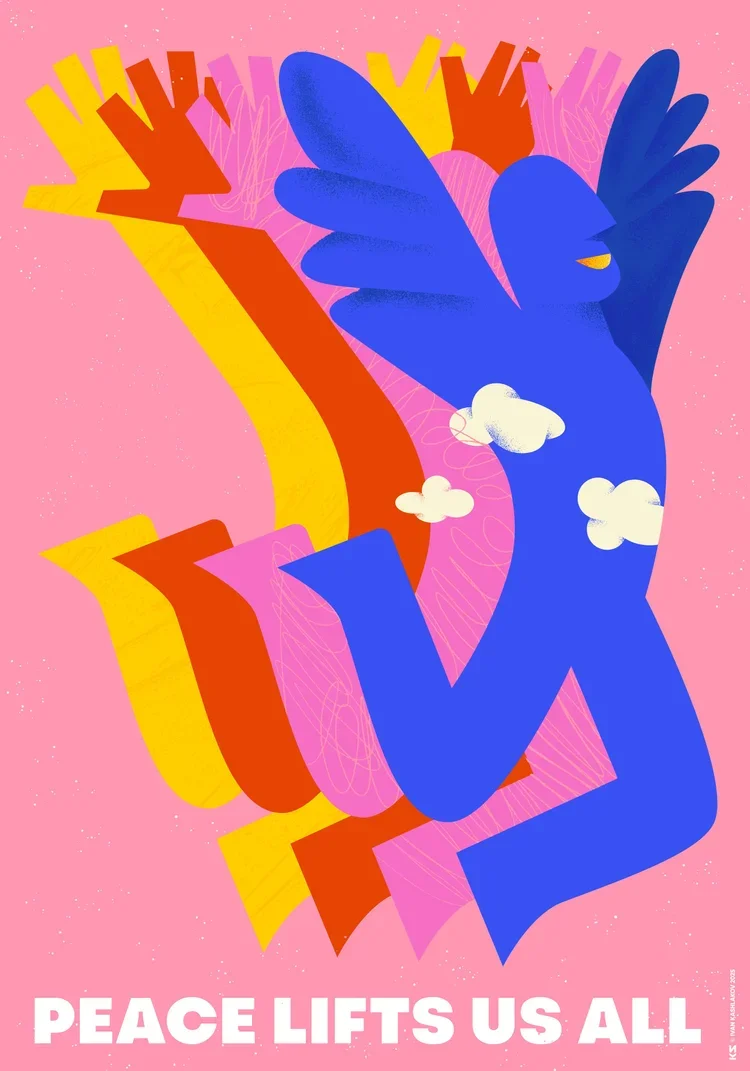
Peace Lifts Us All - 2024 Ivan Kashlakov
Keep imagining peace
At Peace Museums, we believe that art has an important role to play in this process. Posters4Peace is an ongoing project because the conversation about peace should never be finished. Every new poster adds another perspective, another culture, another experience, another color, another possibility. Together, these works create something more than a collection of posters. They create a growing visual conversation about what peace can mean — and what it could become. We invite artists, designers, educators, museums, cultural organizations and everyone interested in peace to contribute to this conversation.
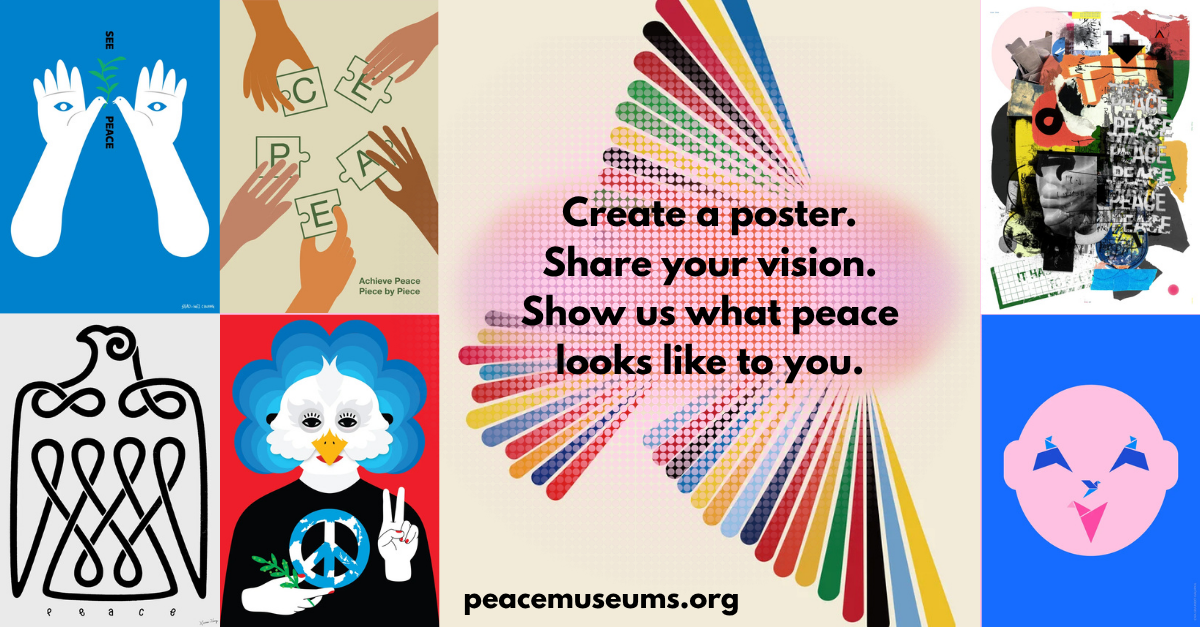
Create a poster. Share your vision. Show us what peace looks like to you.
Because peace should not only be something we wish for. It should be something we learn to recognize, something we talk about, something we practice — and something we make visible.
Keep imagining peace. Keep creating peace. Keep sharing your vision.
Submit your poster to Posters4Peace. Share your peace.
#PositivePeace #PeaceEducation #PeaceArt #PeaceMuseums #Posters4Peace#Peacebuilding #CultureOfPeace #VisualPeace #ArtForPeace #PeaceAndJustice#PeaceActivism #PeaceDesign #ImaginePeace #MakePeaceVisible #ShareYourPeace
